
Copperline 0.10.0: the 68060, the MMUs and a much bigger debugger
0.10.0 is the largest Copperline release so far. The headline is CPU work: a 68060 model joins the family, and the 68030 and 68040 get MMU and cache behaviour. Around that are a debugger with a command console and three new tabs, the A4091 Zorro III SCSI board, host MIDI and TCP bridges for Paula's serial port, selectable audio output and zipped floppy images. There is also another broad pass over CPU, Copper, Agnus, Denise, Paula, CIA, blitter, floppy and display timing.
(This write-up is five days late, and 0.11.0 shipped in the meantime.)
As always, when something doesn't run, the fix models the underlying Amiga subsystem more faithfully rather than special-casing the title.
The 68060
Copperline now covers the 68k line up to the 68060. The 68060 profile
models superscalar dual-issue pairing, the branch cache,
LPSTOP, the reduced FPU with unimplemented-instruction traps,
and the 060's exception frames and MMU specifics. Like every other CPU,
it is selectable from the launcher and the config file.
...and real MMUs below it
The 68030 and 68040 gained the paged MMU: translation, the transparent translation registers, the ATC, access-error frames, write-protect and permission faults, and MOVE16 alignment behaviour. The 68040 also gained its instruction and data caches. All of it is backed by expanded CPU fixture tests.
One default changed alongside this. CPUs with on-chip caches now enable
them by default, as shipped 68020+ machines did. For the old cache-off
behaviour, set [cpu] icache = false and/or
dcache = false.
The debugger: a console and three new tabs
Cmd+K opens a GDB-flavoured command console in its
own tool window. From it you can inspect and modify memory and registers,
HUNT for byte patterns, TRACE START /
STOP, set catchpoints, walk a heuristic call stack, list the
tasks and segments of a running AmigaOS, and give the reverse runner
explicit targets. The console accepts clipboard paste, and a multi-line
paste executes line by line, so a saved command script replays with one
paste.
Three new tabs joined CPU, Chipset, Copper, Memory and Break:
- Video shows the display pipeline with layer isolation. Hide individual bitplanes and sprites in the presented picture to work out which layer is drawing that by elimination. It is an output-only filter: collisions and priority still use the true data, so it cannot affect the emulation.
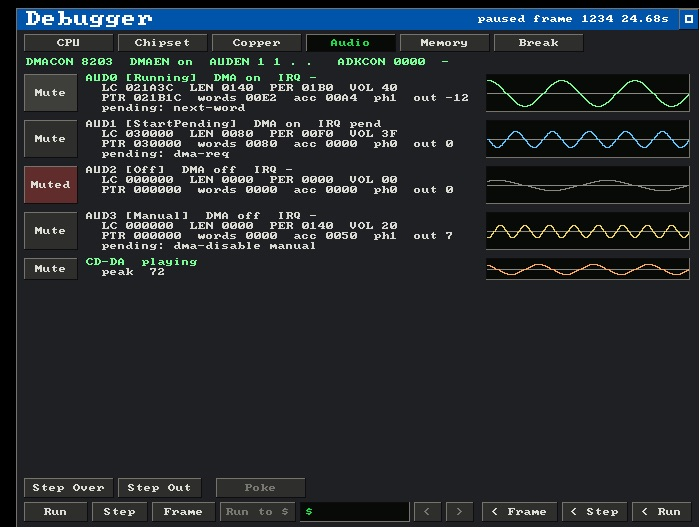
- Audio decodes Paula's four channels: each channel's DMA state machine, latches, pointer and live output, with a mute button and an oscilloscope per channel. A fifth row shows CD-DA on CDTV / CD32.
- IO Map is a browsable map of the whole custom bank, showing every register's live value with the selected register's bits decoded by name.
The Copper tab gained breakpoints and single-stepping: stop when the Copper's PC reaches an address, or retire one Copper instruction at a time. Watchpoints report more about the write that triggered them, and beam scrubbing in the Frame Analyzer is smoother.
A4091 SCSI
Bernie Innocenti (@codewiz)
contributed an A4091, the Zorro III SCSI board. The model covers
nibble-wide autoboot ROM exposure, the DMA and SCSI FIFOs, the NCR SCRIPTS
processor's register and memory moves, interrupts, looped SCSI pins, bus
reset, and drive scan and mount. Diagnostics are available under
COPPERLINE_DIAG_A4091.
Host I/O: MIDI, TCP serial, audio outputs, zipped floppies
Paula's serial port can now bridge to host MIDI, contributed by Lee Hobson (@hobbo91), or to a bidirectional TCP sink, contributed by Bernie. Lee also added host audio-device selection with mono / stereo shaping, and Cmd+Shift+A to cycle audio outputs while running. jbl007 (@sonnenscheinchen) added ZIP-wrapped floppy images, so a zipped ADF loads directly.
The hardware pass
The usual long tail of timing fixes, each prompted by a real program:
- 68000 / 68010 interrupt recognition tightened against microcode and cputest coverage: IPL poll placement, dispatch idle clocks, STOP wake timing, 68010 prefetch refill, and MOVES and MOVE-from-CCR timing.
- The Copper follows its fetch pipeline more closely: WAIT / SKIP / COPJMP execution, dormant COPxLC writes retargeting the Copper PC, skipped MOVEs still passing illegal-register decode, and the vertical-blank COP1LC restart at the hardware position.
- The DDF sequencer models its start / stop flip-flops, with raw below-hard-start fetch origins, FMODE=0 placement, DIW comparator anchoring, overprogrammed-BPU suppression and sprite DMA slot state.
- Normal and line-mode blits follow a per-slot micro-cycle protocol, including BLTPRI / CPU starvation interactions and completion / IRQ prediction under active Copper DMA.
- Paula audio moved to the HRM channel state machine, with AUDxEN disable deferred to the word boundary. CIA accesses synchronize to the E clock, and floppy step pulses observe a mechanism floor.
Config and save states
Apart from the cache default noted above, no config changes are required from 0.9.0. Everything new is optional. Save states bump their format version to carry the new CPU, MMU, cache and board state. Older files are refused with a version error rather than misread.
The known issue
0.10.0 shipped with known visual regressions in some display paths. They are fixed in 0.11.0.
Get it
Builds for macOS, Linux and Windows are on the release page. With 0.11.0 already out, you probably want that instead.
- Andrew Hutchings (LinuxJedi) · linuxjedi.co.uk